
By Integrity Rodent Proofing, Dixon, California. Updated November 14, 2026
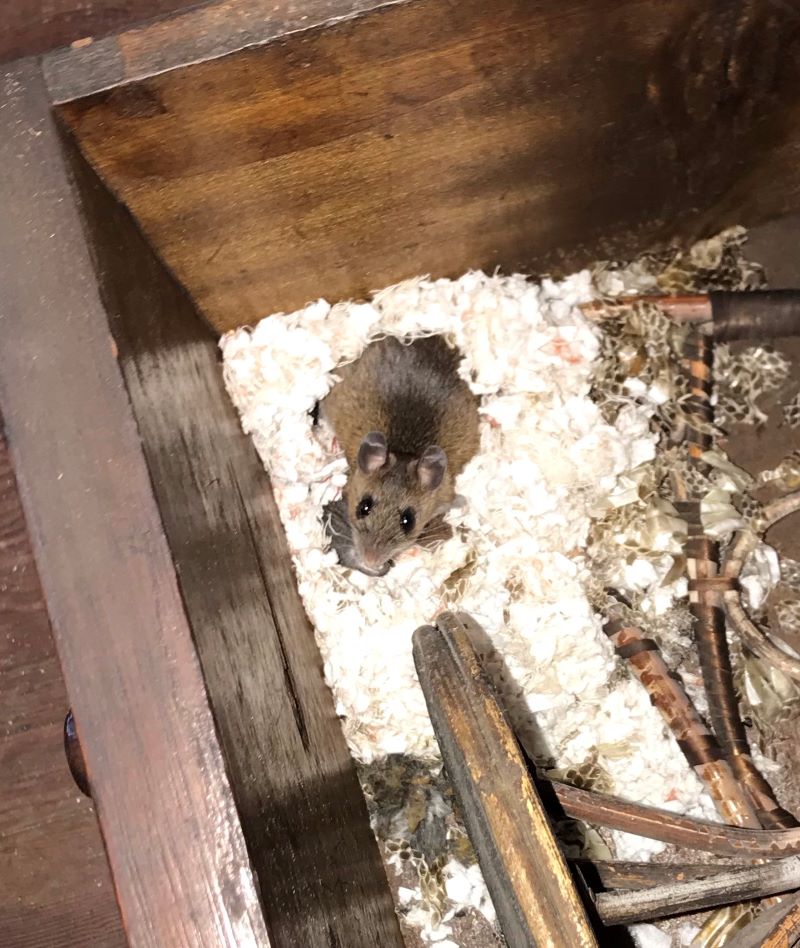
Photo: NPS Photo (U.S. National Park Service, nps.gov), public domain.
Key takeaways
- Mouse droppings are the giveaway: dark pellets the size of a grain of rice, 1/8 to 1/4 inch long with at least one pointed end, scattered along walls, in drawers, and behind appliances.
- Size separates mice from rats: rat droppings run about 1/2 to 3/4 inch, wider and blunt at the ends, and rat gnaw and rub marks are heavier.
- Mice travel along walls and work at night, so the signs line their routes: light scratching after dark, rub marks at baseboards, tiny tracks in dust, a musky smell in cabinets.
- Nests turn up in quiet, warm places: shredded paper, fabric, cardboard, or insulation tucked into a drawer, a stored box, a wall void, or behind an appliance.
- Old signs can sit for months. Fresh droppings, new gnaw marks, or droppings back after cleaning mean mice are still active.
Droppings: the sign that settles it
Droppings are usually the first hard evidence. Mouse droppings are small, dark pellets, roughly the size and shape of a grain of rice: 1/8 to 1/4 inch long, smooth, with at least one end pointed. Look where mice travel and feed: along baseboards, in kitchen drawers and cabinets, under the sink, and behind the stove and refrigerator. One mouse can leave 50 to 75 droppings in a day, so a big scatter does not by itself mean a big infestation. What matters is pellet size and shape, and whether new ones keep appearing. Rat droppings are the ones homeowners confuse them with, and the difference is not subtle: rat pellets run about 1/2 to 3/4 inch, wider, and blunt at the ends instead of pointed.
Gnaw marks and chewed packaging
Mice gnaw constantly, and the marks are small. Fresh mouse gnaw marks are tiny, about 1/32 inch wide, and lighter in color than the surface around them; older marks darken and smooth out. Check food packaging first: cereal boxes, pet food bags, anything in cardboard, where mice can chew a clean hole about 1 1/2 inches across. Then cabinet corners, baseboards, and garage storage. The gnaw mark that changes the urgency is on wiring: mice chew the covering off electrical wires in walls and attics, and bare wire is a fire risk, not just a pest problem.
Hearing scratching? Finding droppings?
Let's find out how they're getting in.
An entry-point inspection checks the common ways rats and mice get in, shows you what we find, and tells you what needs to be sealed.
Sounds, smells, and the trails in between
Most mouse noise happens after the house goes quiet. It is light: scratching, pattering, and scurrying in a wall, a ceiling, or the attic. Rat activity sounds heavier, with thumps and slower movement. Smell is the second trail. Mice urinate as they travel, so their routes pick up a sharp, ammonia-like odor that turns musky as it builds, strongest in closed cabinets and nesting areas. In a heavy, long-running infestation, urine deposited along one route again and again can build into small pillars. The third trail is on the surfaces: dark, greasy rub marks where bodies brush baseboards, pipes, and hole edges along a repeated route, and tiny footprints with tail-drag lines in dust. Mouse rub marks stay small and low; broad, continuous smears at joist or pipe height point to rats.
Nests: where the signs lead
Follow the droppings and rub marks and they usually end at a nest. A mouse nest is a loose ball or tucked wad of finely shredded material: paper, fabric, cardboard, insulation, whatever soft material is close. Mice build where it is quiet, warm, and undisturbed, and near food: inside drawers, in stored boxes, in wall voids, in attic insulation, behind appliances. Shredded material where you did not leave it, especially with droppings around it, is a nest until proven otherwise. Mice stay close to home, so droppings, gnawing, and nest tend to sit in one part of the house.
Fresh signs, old signs, and how much activity
A house can carry old mouse sign long after the mice are gone, so the real question is whether the signs are current. Fresh droppings are dark, shiny, and soft; old ones turn gray, dusty, and crumbly. The reliable test is change: once a spot with droppings has been cleaned, new pellets there over the next few days mean mice are still using that route. Signs in one drawer can be one mouse passing through. Droppings in several rooms, scratching in more than one wall, and a nest or two mean an established problem. A mouse seen in daylight counts too: mice work at night, and daytime sightings often mean a crowded nest.
What actually ends a mouse problem
The signs do not close the way in, and a mouse needs a gap of only about a quarter inch: a worn door sweep, a pipe penetration, a garage door corner. Our work starts with sealing those openings with construction grade materials, at mouse size. At the same visit, droppings and nesting material get cleaned and sanitized. Then traps take the mice still inside, and follow-up checks continue until there are no more signs of activity. No poison at any point. Trapping first, or cleaning without sealing, leaves the route open and the signs come back. A rodent inspection covers the whole house, not just the room where the sign turned up, and our guide to what a rodent inspection covers lays out the visit area by area.
Mouse work in our service area
Common questions
What are the first signs of mice in a house?+
Usually droppings: small, dark, rice-sized pellets along a baseboard, in a drawer, or behind an appliance. Light scratching in a wall after dark, tiny gnaw marks on food packaging, and a musky smell in a closed cabinet are the other early ones. One is worth checking; two together settle it.
How do I tell mouse droppings from rat droppings?+
By size and shape. Mouse droppings run 1/8 to 1/4 inch, thin, with at least one pointed end. Rat droppings run about 1/2 to 3/4 inch, wider, and blunt at the ends.
I hear scratching in the wall at night. Is it mice or rats?+
Mice sound light: scratching, pattering, and quick scurrying, sometimes in several walls. Rats sound heavier, with thumps and slower movement. The droppings near the sound settle it.
If I see one mouse, are there more?+
Often, yes, but droppings will not tell you how many: one mouse can leave 50 to 75 a day. One sighting can be a mouse passing through; nests, signs in several rooms, or droppings that return after cleaning point to more.
What happens after I find the signs?+
The next step is a free inspection. We trace the droppings, rub marks, and gnawing back to the openings they are using, photograph what we find, and give you an estimate for sealing them. Same-week inspections are available, and the work runs sealing first, clean-up and sanitation at the same visit, then trapping and follow-up checks until there are no more signs.
Written by
The Integrity Rodent Proofing team
Dixon, California. Rodent-proofing specialists serving homes across Solano, Yolo, Sacramento, Napa and Placer counties. We find how rats and mice are getting in, explain what we find, and seal the openings.