
By Integrity Rodent Proofing, Dixon, California. Updated November 17, 2026
Key takeaways
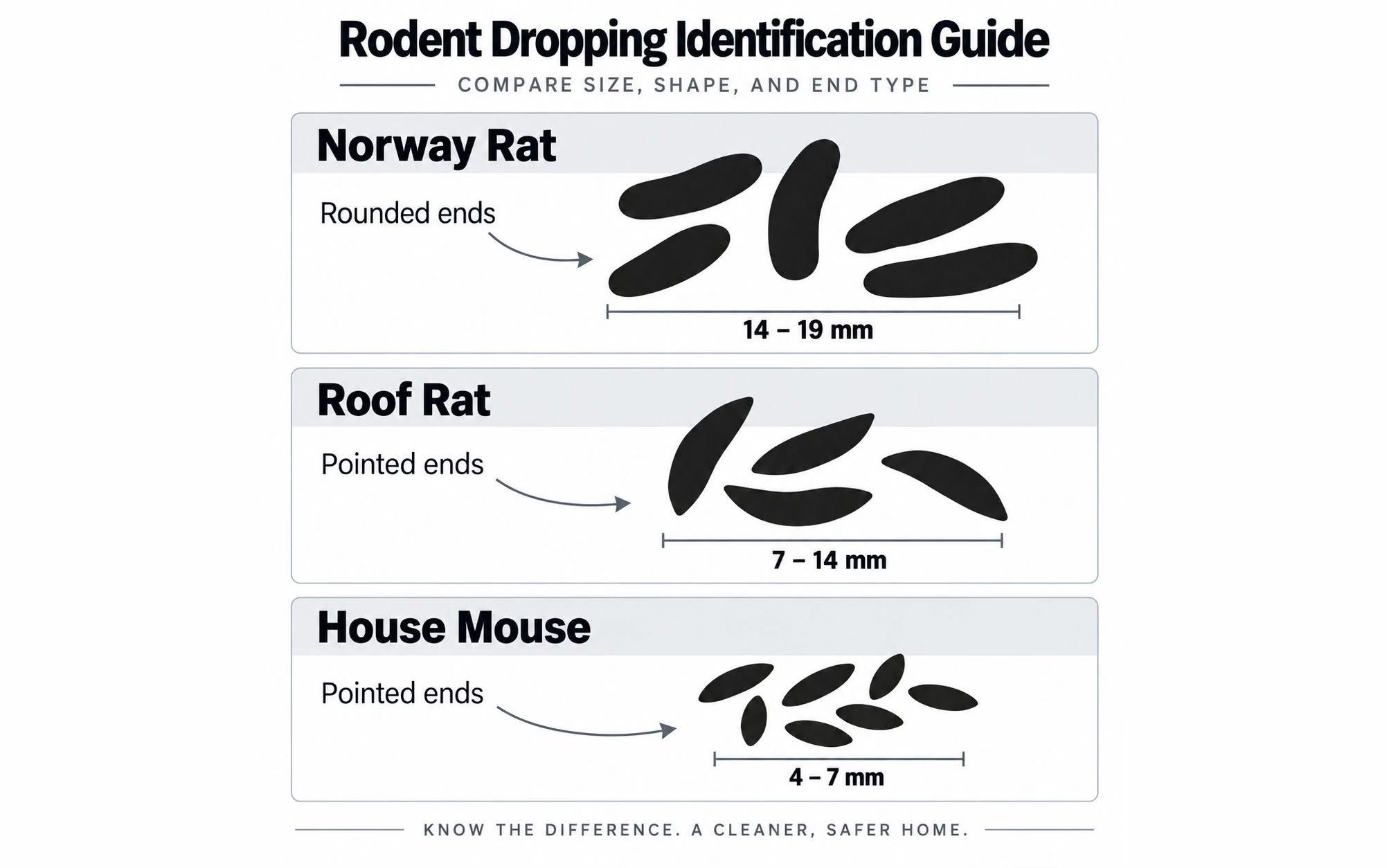
- Rat droppings are raisin-sized pellets: about three quarters of an inch, thick and blunt-ended from Norway rats; about half an inch, slim and pointed from roof rats.
- Mouse droppings are the main mix-up: an eighth to a quarter of an inch, thin, pointed, scattered like dark grains of rice.
- Fresh droppings are dark, shiny, and soft. Old ones dry dull, turn gray, and crumble.
- Rats group their droppings along the routes they run. Where the groups sit, high or low, points to the species.
- Handle any droppings the careful way: wear gloves, wet them with disinfectant, and wipe them up; never sweep or vacuum them dry.
What rat droppings look like
Four things identify a dropping: size, shape and ends, color, and grouping. A Norway rat dropping is the big one: about three quarters of an inch long, thick, capsule-shaped, with blunt, rounded ends, about the size of a raisin. Norway droppings sometimes show fine hairs, swallowed while the rat grooms. A roof rat dropping is smaller and slimmer: about half an inch, spindle-shaped, often slightly curved, tapering to pointed ends. Size can mislead on its own, because a young rat leaves smaller droppings; the ends are the tiebreaker. A thick, blunt-ended pellet reads Norway rat at almost any size; a slim, pointed one, longer than a grain of rice, reads roof rat.
Rat droppings or mouse droppings?
Mouse droppings run an eighth to a quarter of an inch, thin rods pointed at one or both ends, dark grains of rice next to the rat's raisin. The pattern separates them too. Mice scatter droppings widely as they travel, and one mouse leaves 50 to 75 a day, so mouse sign spreads thin across drawers and shelves. Rats leave fewer, larger droppings, 40 to 50 a day from one rat, grouped where they feed and run, so rat sign builds in clusters. A few small droppings mixed among large ones usually mean young rats, not mice; read the biggest pellets in the pile first.
Hearing scratching? Finding droppings?
Let's find out how they're getting in.
An entry-point inspection checks the common ways rats and mice get in, shows you what we find, and tells you what needs to be sealed.
Fresh or old: the activity test
Color and feel date the sign. Fresh droppings are black, shiny, and soft enough to dent under a stick. Over a few days they dry, harden, and lose the shine. Over a few weeks they fade gray or dusty brown and crumble when pressed. A pile is often both: gray underneath, dark on top, an old route still in use. When the read is not clear, run the test that settles it. Clean the spot the careful way below, wait two or three days, and look again. New droppings in a cleaned spot mean rats are active now. Nothing new means the sign is probably left over.
Where they collect, and what the pattern means
Rats do not drop at random. Droppings collect along the routes rats run nightly: against walls, along attic rafters and on top of insulation, behind appliances, and around stored food and pet food. The height is a species clue. Droppings up high, attic and roofline, point to roof rats; down low, crawlspace, garage, and foundation, point to Norway rats. Groups in several areas mean the route is established, not a single pass-through. What droppings map is the route: where the rats travel, feed, and rest, with the openings at its ends. Finding those openings takes an inspection of the roofline, vents, garage, and foundation.
What else it could be
Not every dark pellet is a rat. Squirrel droppings come closest: near rat size, but thicker, barrel-shaped with rounded ends, often lighter brown, and found in attics near a chewed roofline opening. Squirrels are daytime animals, so daytime noise fits them better. Bat droppings collect in a pile under one roost spot and crumble into shiny fragments of insect shell; a rat pellet holds together. Cockroach droppings are specks, like ground pepper or coffee grounds, never pellets. Seed husks and soil crumbs fail the simplest test: real droppings are near-uniform in size and shape; debris is not.
What to do when you find them
Start with handling. Air the space out first. Never sweep or vacuum dry droppings; that puts their dust into the air. Wear gloves, spray the droppings and the area around them with disinfectant until soaked, let it sit, then wipe them up with paper towels, bag them, and wash your hands. That is the safe first pass for a small find. How much clean-up a heavy mess needs, and when insulation has to come out, is its own question; our rodent droppings and clean-up guide covers it. The droppings are the smaller problem: they mean a route is open. Our work starts by reading the sign back to the openings, then sealing those openings with construction grade materials. Clean and sanitize happen at the same visit, trapping follows for the rats still inside, and follow-up checks run until there are no more signs of activity. The inspection is free.
Rat work in our service area
Common questions
What do rat droppings look like?+
Norway rat droppings run about three quarters of an inch, thick and capsule-shaped with blunt ends, about the size of a raisin. Roof rat droppings run about half an inch, slim and spindle-shaped with pointed ends.
How can I tell rat droppings from mouse droppings?+
Size first. Mouse droppings are an eighth to a quarter of an inch, thin and pointed, like dark grains of rice, and they scatter widely. Rat droppings are two to three times longer, much thicker, and collect in groups along their routes.
How do I know if the droppings are fresh?+
Fresh droppings are dark, shiny, and soft; old ones are dull, dry, gray, and crumbly. If you cannot tell, clean the spot carefully and check again in two or three days; new droppings mean the rats are still active.
How many droppings does a rat leave in a day?+
About 40 to 50 from one rat. The count builds fast along a route, but it does not tell you how many rats there are: one rat on a nightly route can cover a corner in a week. Fresh droppings returning after a clean-up say more than any count.
I found droppings but have not heard or seen anything. Are the rats gone?+
Maybe, and the droppings themselves will tell you. If every dropping is gray, dry, and crumbly, the sign may be left over from an old problem; old droppings can sit undisturbed for years. Dark, shiny droppings mixed in, or new droppings after you clean the spot, mean rats are still using the route, even if you never hear them.
Written by
The Integrity Rodent Proofing team
Dixon, California. Rodent-proofing specialists serving homes across Solano, Yolo, Sacramento, Napa and Placer counties. We find how rats and mice are getting in, explain what we find, and seal the openings.