
By Integrity Rodent Proofing, Dixon, California. Updated October 2026
Key takeaways
- Mouse droppings are about a quarter inch and pointed. Rat droppings are about half an inch. Size settles most arguments.
- Mice sound light and work low, near food. Roof rats sound heavier and work the attic and roofline.
- Rats leave greasy rub marks on their travel routes. Mice leave fine gnaw marks and small nests.
- The fix is the same either way: identify, seal the openings, and trap what is inside. Identification aims the work.
Start with the droppings
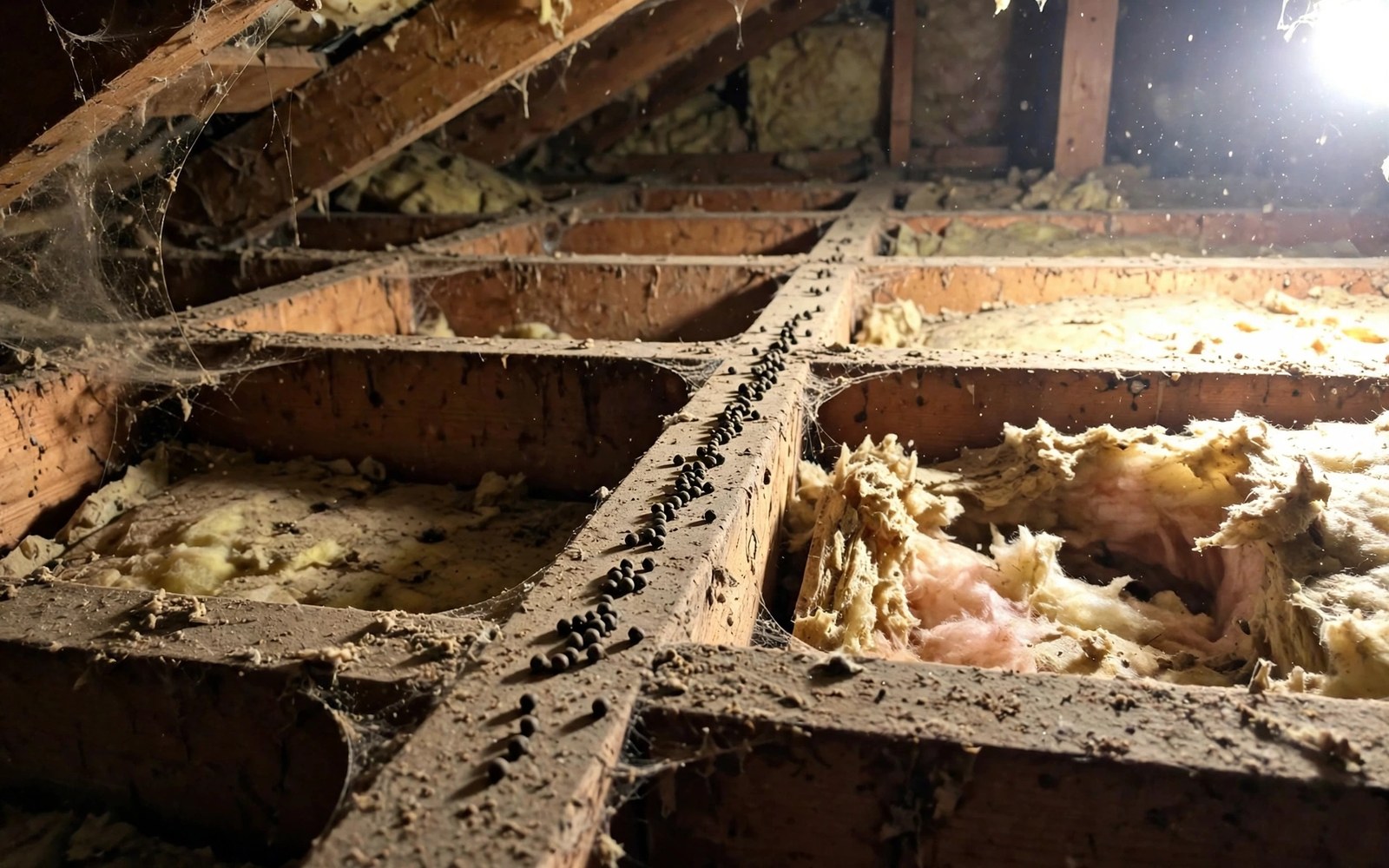
Droppings are the fastest tell. Mouse droppings are small, about a quarter inch long with pointed ends, along walls, in cabinets, and around food storage. Rat droppings run about half an inch and heavier, along attic beams and on the runs rats travel. Roof rat droppings are spindle shaped. Norway rat droppings are blunter. If the droppings are big, it is not mice, no matter what you were hoping.
Listen to the sounds
Both animals are active at night, but they do not sound the same. Mice are light and quick: faint scratching and short scurrying bursts. Rats are heavier and slower, with more gnawing, and roof rats work the ceiling above bedrooms. Heavy noise at dawn and dusk is more often squirrels. Sound alone does not settle it. Droppings and location do.
Hearing scratching? Finding droppings?
Let's find out how they're getting in.
An entry-point inspection checks the common ways rats and mice get in, shows you what we find, and tells you what needs to be sealed.
Look at where the signs are
Roof rats live high. They climb trees, fences, and lines to the roof and nest in attics. Their signs sit at the roofline: droppings on beams, gnawed vent screens, rub marks. House mice live low and close to food: garages, kitchens, wall voids, crawlspaces, in through gaps as small as a quarter inch. Norway rats work the ground: burrows at foundations and field edges. Where the evidence sits is the map of which animal you have.
Check the marks they leave
Rats leave dark, greasy rub marks along the beams, pipes, and edges they travel. Their gnaw marks are larger and rougher, on wood, pipes, and stored items. Mice leave finer gnaw marks near food, and shred paper or insulation into small nests. Chewed wiring shows up with both. It is one reason not to wait.
Does it change what you do?
Less than you would think. The fix is the same: identify the animal and its entry points, seal the openings with construction grade materials, then trap the rodents inside. Identification changes the aim: roofline first for roof rats, ground level and garage first for mice. Poison is not part of our work.
When to call for an inspection
Call when you hear nightly activity, find droppings, or see rub marks or gnawing. One mouse in a trap almost never means one mouse. Our inspections are free: we check the roofline, attic, garage, and crawlspace, show you the openings, and give you a written estimate. Call (707) 754-2408.
Common questions
How can I tell rat droppings from mouse droppings?+
Size and shape. Mouse droppings are about a quarter inch with pointed ends. Rat droppings are about half an inch, spindle shaped for roof rats, blunter for Norway rats.
The scratching is at night. Does that tell me which animal it is?+
Partly. Mice sound light and quick. Rats sound heavier, with more gnawing.
If the fix is the same, why does identifying the animal matter?+
It aims the work: roofline and attic first for roof rats, ground level and garage first for mice.
Can I just set traps and skip the inspection?+
Traps remove the rodents you catch. They do not find or close the openings, so the next group uses the same route in.
Written by
The Integrity Rodent Proofing team
Dixon, California. Rodent-proofing specialists serving Dixon, Davis, Woodland, Winters, Vacaville, West Sacramento, Sacramento, Roseville, and Folsom. We find how rats and mice are getting in, explain what we find, and seal the openings.