
By Integrity Rodent Proofing, Dixon, California. Updated November 19, 2026
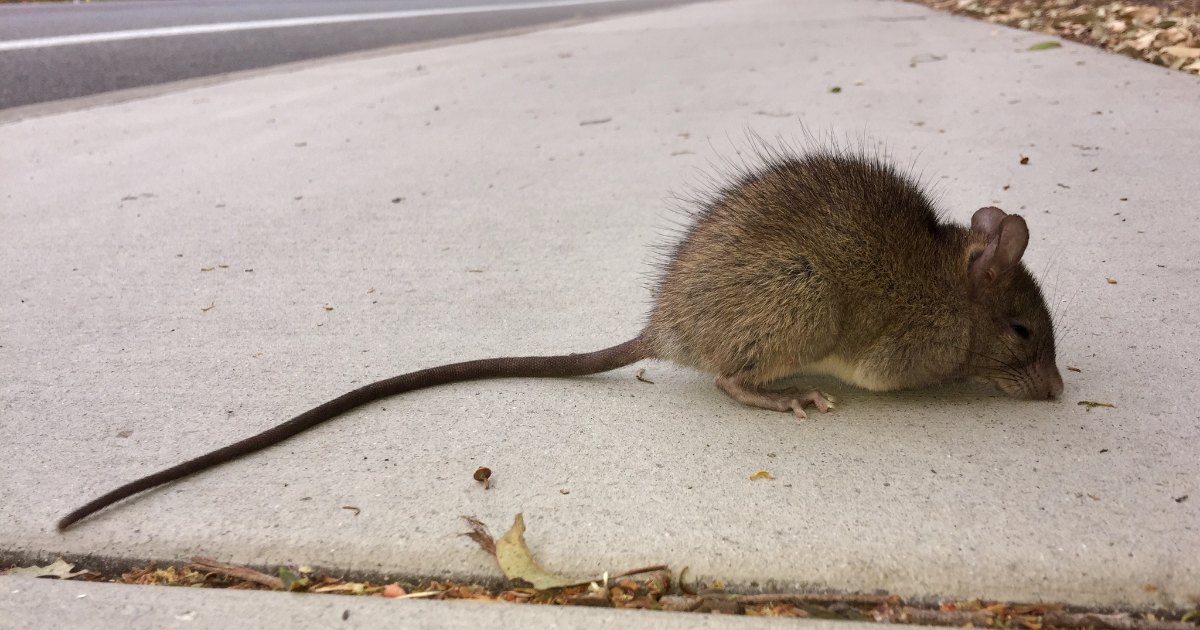
Photo: "Roof rat on a concrete sidewalk" by Gjon Hazard, CC BY 4.0, via iNaturalist.
Key takeaways
- A rat cannot chew through sound, cured concrete of normal thickness.
- Cracked, crumbling, or poorly cured concrete, concrete block, and mortar are a different story: rats work the weak spots.
- Rats chew through wood, plastic, drywall, insulation, foam, caulk, and soft metals like lead and aluminum sheeting.
- Teeth need an edge to start. Flat, hard surfaces resist gnawing; cracks, corners, joints, and gaps around pipes give them one.
- Norway rats often skip the concrete entirely and dig under the slab. A burrow at a slab edge is a tunneling sign, not a chewed hole.
The concrete answer, by condition
Sound, cured concrete stops a rat. A solid slab or foundation wall of normal thickness is more than its teeth can start on, and concrete at proper thickness is a standard rodent-proof building material. Poor concrete is not protected by the name. Concrete mixed weak, poured thin, or not fully cured can be clawed and gnawed, and concrete block is softer than poured concrete: rats gnaw block itself and work its mortar joints. Until a cement patch has fully cured, a rat using that spot can work at it, which is why a patch over an active opening needs the opening dealt with, not just covered.
Why edges, cracks, and joints fail first
A rat's front teeth curve slightly inward. On a flat, hard surface that shape works against the rat: there is nothing to bite into. Give it an edge and the same teeth work fast. That is why the damage shows up where it does: the corner where a wall meets the foundation, the joint where two concrete sections meet, a crack that has started to flake, a crumbling mortar joint between bricks or blocks, and the soft fill packed around a pipe or cable where it passes through a wall. Most holes blamed on rats chewing through concrete started as one of those weak spots, widened from a crack or a gap until a rat could fit. A rat needs an opening of about half an inch; a mouse needs about a quarter inch.
Hearing scratching? Finding droppings?
Let's find out how they're getting in.
An entry-point inspection checks the common ways rats and mice get in, shows you what we find, and tells you what needs to be sealed.
What rats chew through easily
Most of a house is softer than concrete. Rats gnaw through wood, including joists, framing, doors, and baseboards, and through plywood and drywall. They chew plastic and PVC pipe, rubber, vinyl, insulation, and cardboard and stored goods in the way. Foam and caulk on their own are no barrier at all: a rat goes through either one quickly, which is why a foam-filled gap reopens. Soft metals do not stop them either. Lead and aluminum sheeting and flashing are both gnawable. Wiring takes the worst of it: rats strip insulation off electrical cables and gnaw pipes and soft fittings, and chewed wiring left in a wall or attic is damage worth finding early, before it becomes a failure or a fire risk.
What actually stops them
Short list: sound concrete, solid brick with sound mortar, and thick, hard metal. Everything on that list shares the same condition: it only works whole. Brick stops a rat while its mortar joints hold; once a joint crumbles, the wall has an edge problem, not a brick problem. A concrete wall with an unsealed pipe passing through it is still an opening. The opening, closed completely with no edge left to start on, is the answer.
Under, not through: tunneling
Norway rats dig. They burrow down along foundations and under slab edges, walkways, porches, and garage floors, hollowing out the ground underneath until a run passes below the foundation and up into the crawlspace. A smooth hole at the edge of a slab, with fresh soil beside it, is usually a burrow entrance, not a hole chewed through the concrete. Tunneling changes the job. We check the crawlspace on every inspection, and entry points get sealed unless the ground has been tunneled. Where tunneling has undermined the foundation, the fix is a rat slab, a concrete cap poured over the tunneled ground, and that work gets referred out. Sealing over tunneled ground without the slab leaves the run underneath open.
What to do about a chewed opening
Read the opening first. Fresh gnaw marks are lighter than the surface around them; old marks darken. Droppings, rub marks, or fresh soil near the opening say whether rats are using it now. Our work starts by sealing the openings rats are using, and the ones they could use next, with construction grade materials. Clean and sanitize happen at the same visit, trapping follows for the rats still inside, and follow-up checks run until there are no more signs of activity. A chewed foundation edge or a hole beside a pipe is worth an inspection of the whole house, not just a patch on the one spot, because the route that produced it usually has a second opening. The inspection is free.
Rat work in our service area
Common questions
Can a rat chew through concrete?+
Not sound, cured concrete. A solid slab or foundation wall of normal thickness stops a rat. Cracked, crumbling, or poorly cured concrete, concrete block, and mortar joints are another story, and most of the time the slab problem is not chewing at all: Norway rats tunnel under slab edges and up into the crawlspace.
Can rats chew through cinder block or concrete block?+
Yes. Concrete block is softer than poured concrete, and rats gnaw the block and work the mortar joints between blocks. A block wall with crumbling joints has openings a rat can widen.
Can rats chew through brick?+
Solid brick with sound mortar stops them. The mortar is the weak point: cracked or missing mortar gives teeth an edge to start on, and a joint can be worked until a brick loosens.
Will expanding foam or caulk keep rats out?+
No. Rats chew through foam and caulk quickly, and a gap filled with either one on its own reopens. An opening needs to be sealed with construction grade materials, closed completely, with no edge left.
How do I know if a hole in concrete was made by rats?+
Look for the supporting sign: fresh, lighter-colored gnaw marks on the edges, droppings nearby, rub marks along the route, or a smooth burrow hole with fresh soil at a slab edge. A clean crack with no gnaw marks and no sign around it usually started as settling or wear, and rats found it later.
Written by
The Integrity Rodent Proofing team
Dixon, California. Rodent-proofing specialists serving homes across Solano, Yolo, Sacramento, Napa and Placer counties. We find how rats and mice are getting in, explain what we find, and seal the openings.