
By Integrity Rodent Proofing, Dixon, California. Updated November 18, 2026
Key takeaways
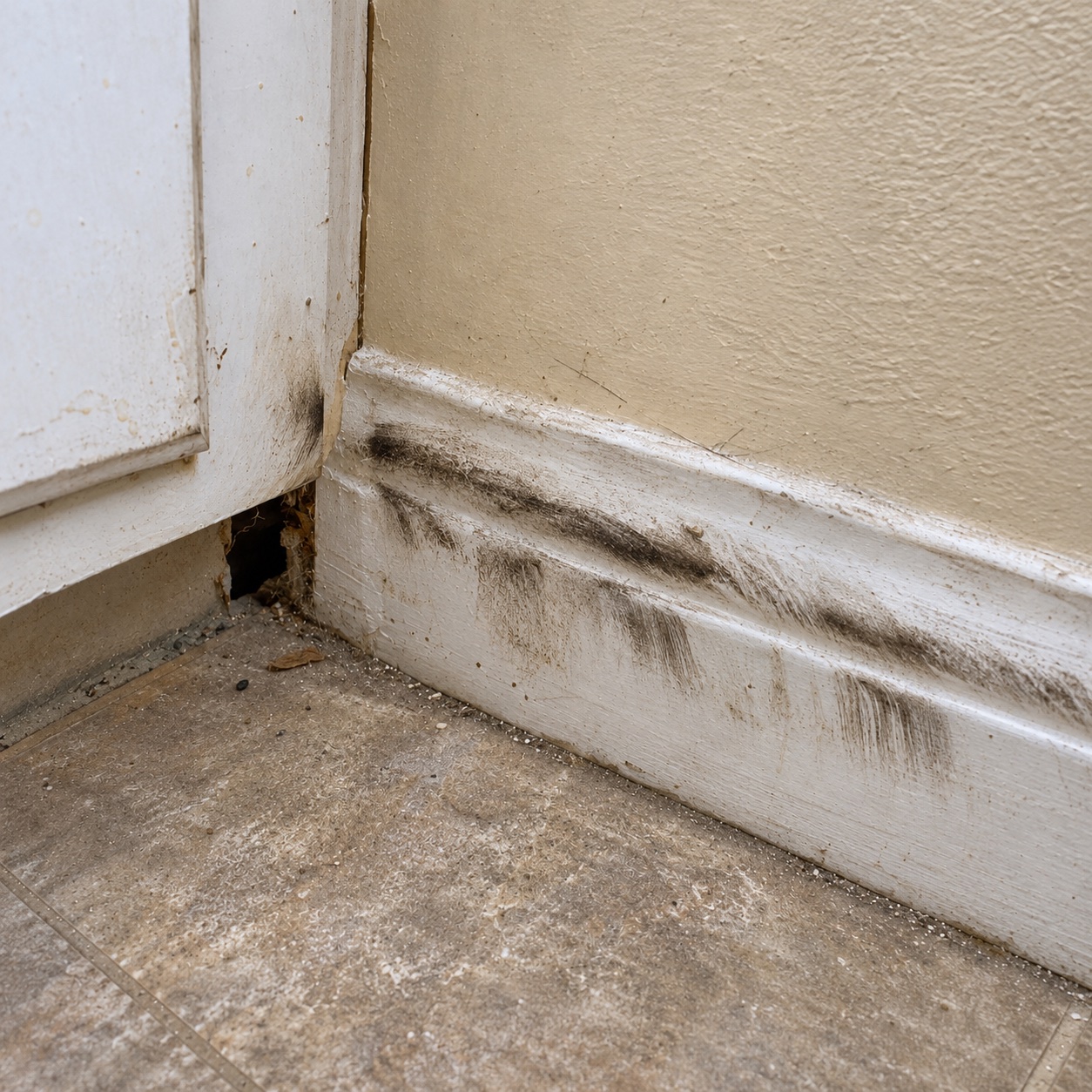
- Rats run the same routes nightly, hugging walls, joists, and pipes, and the travel itself writes the evidence: grease along the edges, prints in the dust.
- Rub marks are body oil and dirt built up trip over trip. A fresh mark smears; an old one dries out and flakes, so the mark also says something about timing.
- Tracks show where dust or dirt sits undisturbed: a hind print about an inch long, with a wavy tail-drag line between the prints.
- A run has two ends: food, water, or shelter at one end, and the opening at the other. The opening is the end that matters.
- Once the openings a run points to are sealed, the marks stop renewing. A grease line going dry is the record of traffic that ended.
Why rats run the same lines every night
Rats see poorly and navigate by touch, memory, and smell, so they travel with one side against something: a wall, a joist, a foundation top, a pipe. The route that works gets used again the next night, and every night after, until the travel itself starts leaving evidence. Body oil and dirt rub off a little at a time where the rat brushes the surface. Feet press prints into undisturbed dust. A well-used route, called a run or a runway, ends up marked two ways: grease along the edges the body touches, tracks on the flat surfaces the feet cross. Droppings say a rat was somewhere. A run shows the road it takes every night, and roads have ends.
Rub marks: the grease line along the run
A rub mark is a dark, greasy smear built up by repeated trips along the same edge. The oil comes from the rat's coat, mixed with the dirt the coat picks up, and transfers a film at a time wherever the body presses or squeezes past. Look along the runs: the tops of joists and bottom plates in the attic, pipe and wire holes, wall bases, and the dark ring around any hole used nightly. Height is a clue to the animal. Marks up high, along rafters and wall tops, are climbing work, usually roof rats. Marks down low, at floor level and along the foundation, belong to the Norway rat, the ground animal. A mark also carries a rough date. Fresh, it is soft and smears under a gloved finger. Old, it has dried out and flakes instead. A dark, still-greasy line means the route is in use now. A pale, flaking one may record a problem that already ended.
Hearing scratching? Finding droppings?
Let's find out how they're getting in.
An entry-point inspection checks the common ways rats and mice get in, shows you what we find, and tells you what needs to be sealed.
Tracks: prints, tail drags, and dust that tells on them
Where a route crosses dust or soft dirt, the feet write it down. In attic dust or crawlspace dirt, look for the hind print first: about an inch long, shaped like a small foot, with the smaller front print beside it. Between the prints, a rat's tail often draws a wavy line as it drags. Mice leave the same record in miniature: prints about a quarter of that size, and a tail drag that is a thread where a rat's is a ribbon. Fresh tracks have sharp edges. Old ones soften as dust settles back over them, and that difference dates the traffic. A stretch of dust with no prints and cobwebs across it is evidence too. When the dust is too thin to hold a print, a light dusting of flour left across a suspected run overnight works as a recording surface. Prints in it by morning confirm the route is live, and they point the way the traffic flows.
Where the run leads, and what gets done about it
Follow any run and it ends somewhere. At one end is what the rat is traveling for: food, water, or the nest. At the other end is how it gets in, and the marks get heavier near the opening, because every trip passes through it. An inspection follows the runs to the openings they point to and seals them with construction grade materials. The order after that is fixed: the house is sealed first, then cleaned and sanitized at the same visit, then the rats still inside are trapped, with follow-up checks until there are no more signs of activity.
Rat work in our service area
Common questions
What do rat rub marks look like?+
Dark, greasy smears on the surfaces a rat brushes night after night: along joists and pipes, at the base of walls, and around holes the rats use. They start faint and darken as trips add up, so the heaviest mark on a route usually sits at the tightest squeeze, often the opening itself.
Where do rats leave tracks and rub marks in a house?+
Wherever the runs are. In the attic, along joists, top plates, and pipes, with prints in the dust. In the crawlspace, low along the foundation and around the access door. In the house, at wall bases, behind appliances, and around pipe holes under sinks. Outside, along the foundation, fences, and the lines rats climb to the roof.
Do rub marks mean rats are still active?+
Not by themselves. A rub mark is a record, and records outlast the traffic. A fresh mark is soft and smears under a gloved finger; an old one is dry and flakes. Read it with the other signs: fresh tracks in the dust, new droppings, sounds at night. If the mark smears and the dust is tracked, the run is live.
Can you tell a rat run from a mouse run?+
Yes, by scale. A mouse run is the same writing in miniature: a fainter grease line, prints roughly a quarter the size, and a hair-thin tail drag where a rat leaves a clear wavy line. The routes differ too. Mice stay close to their nest and food, usually within a room or two. Rat runs cross the whole house, burrow or roofline to food and back.
What happens after you find the runs on an inspection?+
The runs get followed to the openings they point to, and you get photos of what we find and an estimate naming the openings we would seal and the full cost. The inspection is free. Sealing those openings ends the traffic; the trapping and follow-up happen inside a house already closed.
Written by
The Integrity Rodent Proofing team
Dixon, California. Rodent-proofing specialists serving homes across Solano, Yolo, Sacramento, Napa and Placer counties. We find how rats and mice are getting in, explain what we find, and seal the openings.